How These Images Were Made
Note: The in-line images on this page are in JPG format,and rendered at 25% of the original image resolution. Full resolution TIFFfiles may be downloaded, with prior consent (email me) HERE.These images may not be commercially reproduced without permission.
How These Images Were Made
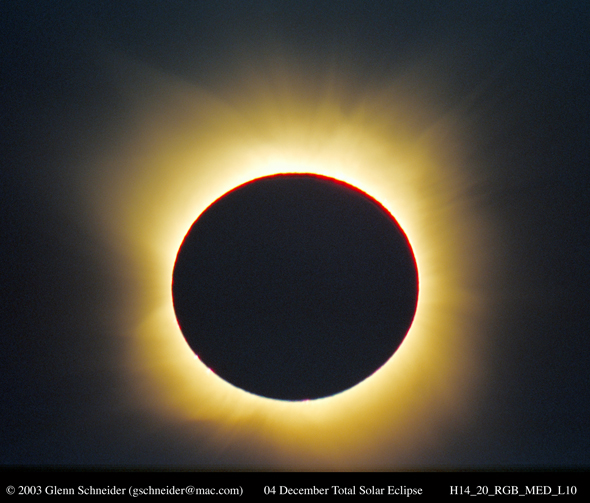
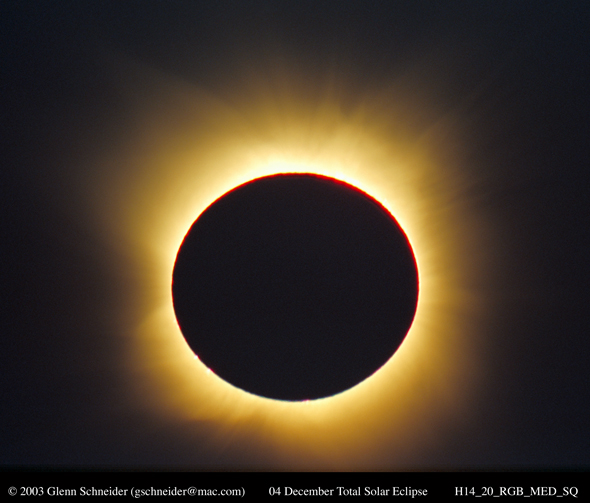
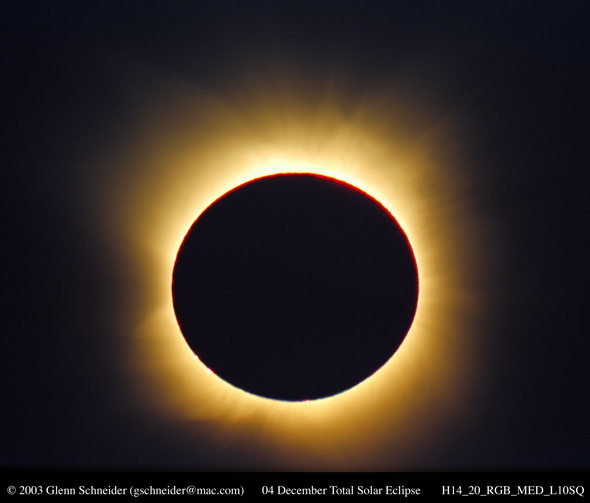
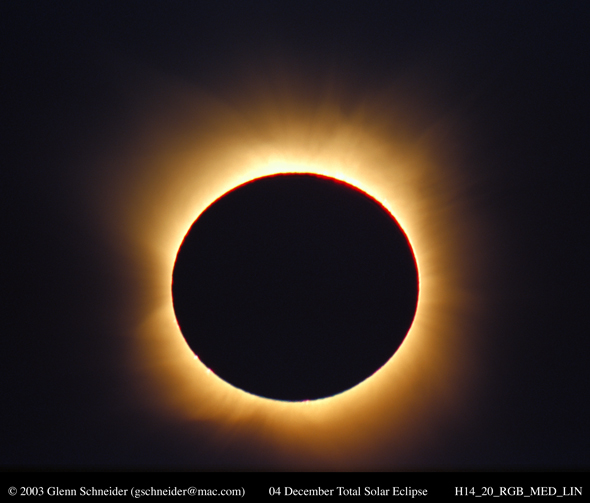
The above images are digital composites from seven exposures taken onFuji NPZ 800 35mm film, push processed to ISO 3200. An automatedcamera, specifically designed for solar eclipse photography with a Nikon1.2 meter focal length f/12 achromatic refractor objective lens (3.94"clear diameter) was used. A detailed summary of the photographicprogram may be found HERE.
The images from which the processed composites were made are centeredon mid-eclipse, span 12.544 seconds in time, and together comprise a totalintegration (exposure) time of 5.942 seconds. The individualframes are exposures 14 — 20 from the automated UMBRAPHILEsequence executed as shown in the thumbnail contact sheet below:
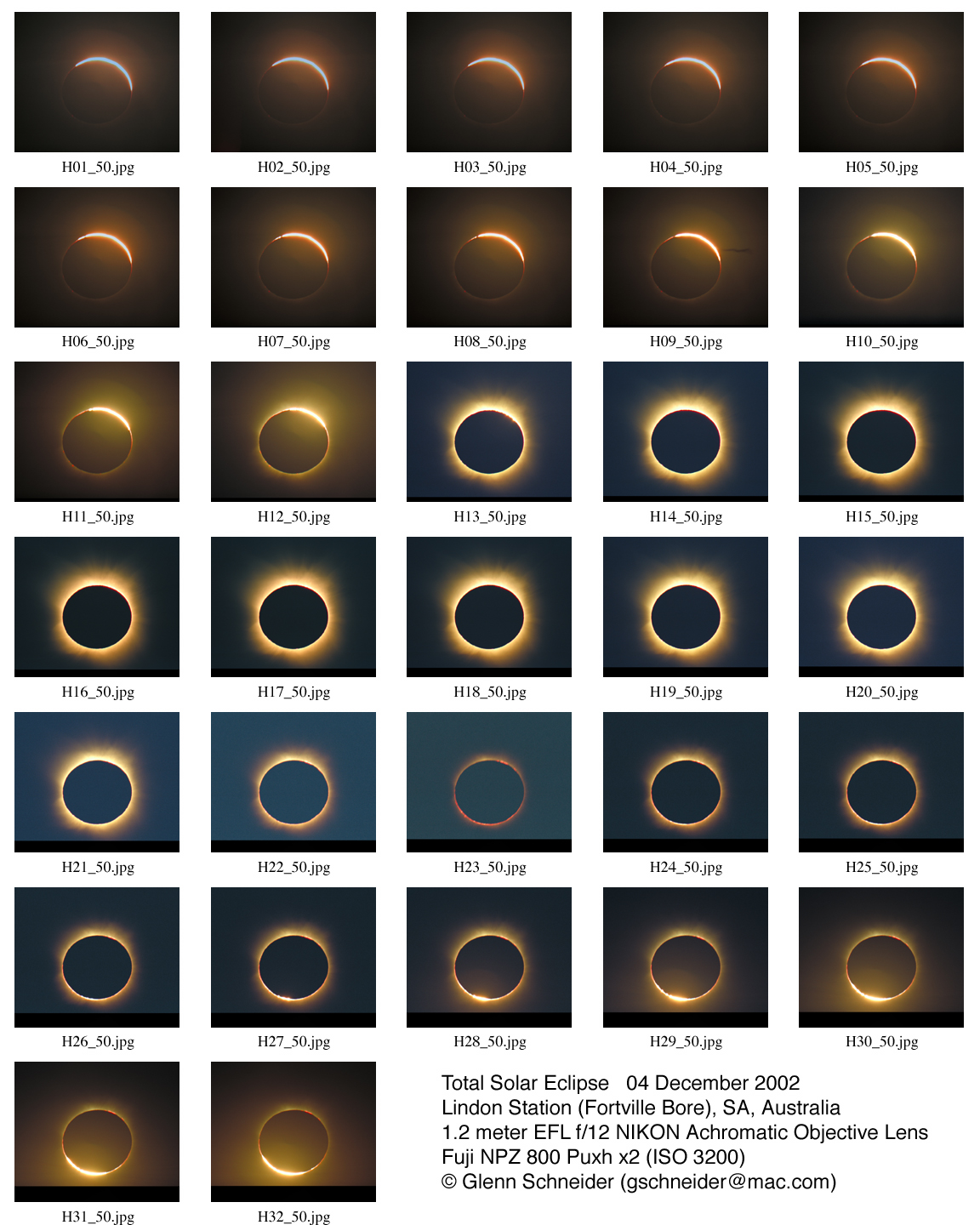
CLICK the above image to see the contact sheet at twice the in-lineresolution.
The above images were digitized (scanned to a Kodak Pro PhotoCD) andgeometrically co-registered by sub-pixel shifting (resampling) via sinc-functionapodized bi-cubic interpolation. Registration was determined by minimizingresiduals in exposure-time weighted difference images of sequential image-pairs. Residuals were computed for regions of the corona and several bright prominances(NOT on the lunar limb - which was moving w.r.t. the Sun).
After registration, the images were digitally separated into Red, Green,and Blue image planes. The seven selected images (H14 - H20) werethen median combined (resampled pixel-by-pixel) in each color plane. The medianed color-plane images were then assigned to R. G, B channelsto make a composite image. The dynamic range of the re-compositedcolor image was re-stretched to exclude unused low-end sampling rangesin each of the three colors (but using the same clipping value for eachcolor plane, so not to shift the color balance as would happen by re-normalizingthe color planes individually.
The re-normalized RGB planes were recompositied with four transformations(hence the four images at the top of the page: Log Base 10 (top), SquareRoot (second image), Log Base 10 * Square Root (third image), and Linear(bottom image).
Software: All quantitative image processing was performed usingIDP3(an IDL based image analysispackage developed by the NICMOS IDT for processingHubble Space Telescope imaging data) and with TRANSFORM(a quantitative image data visualization application under NoeSYS by RSI,a Kodak company). Image compositing and rendering was done with AdobePhotoshop 7.0. All S/W operations, including imageacquisition with UMBRAPHILE, were performed on a Macintosh computer(of course).