A. The next total solar eclipse will occur on 23 November2003. The Moon's umbral shadow will "touch down" on the Earth at22h24m Universal Time (U.T.) and "lift off" at 23h15m U.T.
A. On the long-term average, a total solar eclipse isvisible somewhere in the world about once every sixteen months. However,the overlap between the "cycles" of solar eclipses is complex. Thetotal solar eclipse before the 23 November 2003 eclipse occurred11 months earlier, the next one (which has a maximum duration of the totalphase of 42 seconds) will not happen until 08 April 2005. Also, onaverage, any given spot on the Earth will see a total solar eclipse aboutonce every 360 years. However, eclipse paths can cross specific locationsmuch more frequently (for example the 2001 and 2002 eclipse paths crossedin South Africa), an those living in the right location saw both of them.
A. Only in the Antarctic. The "path of totality",the region on the Earth's surface which will be swept by the Moon's umbralshadow and where the total phase of the eclipse can be seen, begins inthe Antarctic (Great Southern) Ocean and traverses over part of the Antarctic. The eclipse will not be visible from land anywhere except over a smallportion of Antarctica.
A. No.
A. No, but accessibility is difficult. Until this juncturein time (and technology) Antarctic eclipses have been elusive targets.
A. The eclipse geometries can be "unusual". Forexample, with this eclipse, the Moon's shadow passes "over the pole" beforereaching the Earth. So, the eclipse occurs in the hemisphere of theEarth which is experiencing nighttime (except in the Antarctic region),and the path of totality advances across Antarctica opposite the directionof the Earth's rotation.
A. Our planned mid-eclipse intercept, when our Boeing747-400 will be co-located in the center of the Moon's shadow, is at 22h44m Universal Time. We remain flexible, and can intercept the shdowearlier in time (closer to the coast) or later (further inland) in theevent of any obscuring cloud or turbulent air.
A. In the absence of any winds, totality, as seen fromour aircraft with mid-eclipse at 22h 44m UT, will last 2m 35s.
A. It does. From the ground totality (at the locationwhere mid-eclipse occurs at 22h44m U.T.) will last only 01m 59s, thirty-sixseconds shorter than we will experience in our aircraft. Notethat the difference is longer than the maximum duration of totalityexperienced during the last total solar eclipse from Australia on 04 December2002, and is only 8 seconds shorter than the maximum duration of totalityof the next, 04 April 2005 total solar eclipse, in the middle of the SouthPacific Ocean.
A. Our true airspeed will be 470 nautical miles (870.5kilometers per hour).
A. At the 22h 44m UT instant of mid-Eclipse the Moons'shadow will be moving at: 3,888.5 kilometers per hour (2,099.6 nauticalmiles per hour).
A. The aircraft will be moving with a speed of appx 22.4%of the lunar shadow (along its direction of motion at 22h 44m U.T.). Our aircraft will be moving almost in the same direction as the moon'sshadow. Hence the shadow will overtake and pass us more slowly thanan stationary observer on the ground.
A: For the following "baseline" flight parameters:
U.T. Intercept: 22:44:00
Flight Altitude: 38000ft
Heading: 198.72°
Air Speed: 470.0nm/h
Wind Speed: 0.0nm/h
Wind Direction: 0.0°
the circumstances of the total phase of the eclipse areas follows:
TOTALITY DURATION = 2m 34.7s
MID-ECLIPSE INTERCEPT:
LATITUDE = -69° 59' 15.0"S
LONGITUDE = +93° 05' 40.7"E
Solar Altitude = 15.0°
Solar Azimuth = 108.7°
SECOND CONTACT (START OF TOTALITY)
UNIVERSAL TIME = 22:42:42.7
AIRCRAFT LATITUDE = -069°49' 44.5''
AIRCRAFT LONGITUDE = +093° 15' 1.1''
Solar Altitude = +14.9°
Solar Azimuth = 108.9°
Position Angle of Contact = 109.3°
THIRD CONTACT (END OF TOTALITY)
UNIVERSAL TIME = 22:45:17.4
AIRCRAFT LATITUDE = -070°08' 52.9''
AIRCRAFT LONGITUDE = +092° 56' 13.0''
Solar Altitude = +15.1°
Solar Azimuth = 108.5°
Position Angle of Contact = 289.7°
Conditions in flight may call for a mid-eclipse interceptat a different altitude or Universal Time. For lower flight altitudes,at 22h 44m UT, the path of totality shifts anti-sunward (toward an azimuthof 288.7°) by approximately 4000 ft (2/3 nautical mile) for every 1000ft of altitudes below 38,000 ft.
A. Strictly speaking, no, this occurs at a location correspondingto a mid-eclipse near 22h 49.2m U.T.
A. The maximum duration changes very little over thisportion of the path of totality. Indeed the maximum duration of totalitywe could experience from our aircraft (at 22h 49.2m U.T.) is only 0.6 secondslonger than we will experience (at 22h 44m U.T.). To reach that point(and return to Melbourne) would require flying an extra an additional 650km, or 45 minutes. We intend to hold that flight time (and fuel)in reserve, to be "used" prior to the eclipse if needed to compensate forany possible in-flight contingency or delay. If there are none, thattime will be used for the Antarctic sightseeing part of the flight.
A. We will observe the eclipse at the maximum altitudewhich can be supported at this phase of the flight, without necessitatingusing any fuel margins. This will depend somewhat on the actual pre-eclipse(low-level Antarctic overflight) flight plan as well as weather en routeand winds. The "baseline" plan for the eclipse observation describedhere is for 38,000 feet above mean sea level. However, a lower altitude(most likely 34,000 ft or higher) may be required,. This possibilityis anticipated and is easily accommodated in real-time with no significantchange in the duration or viewing aspect of the total eclipse.
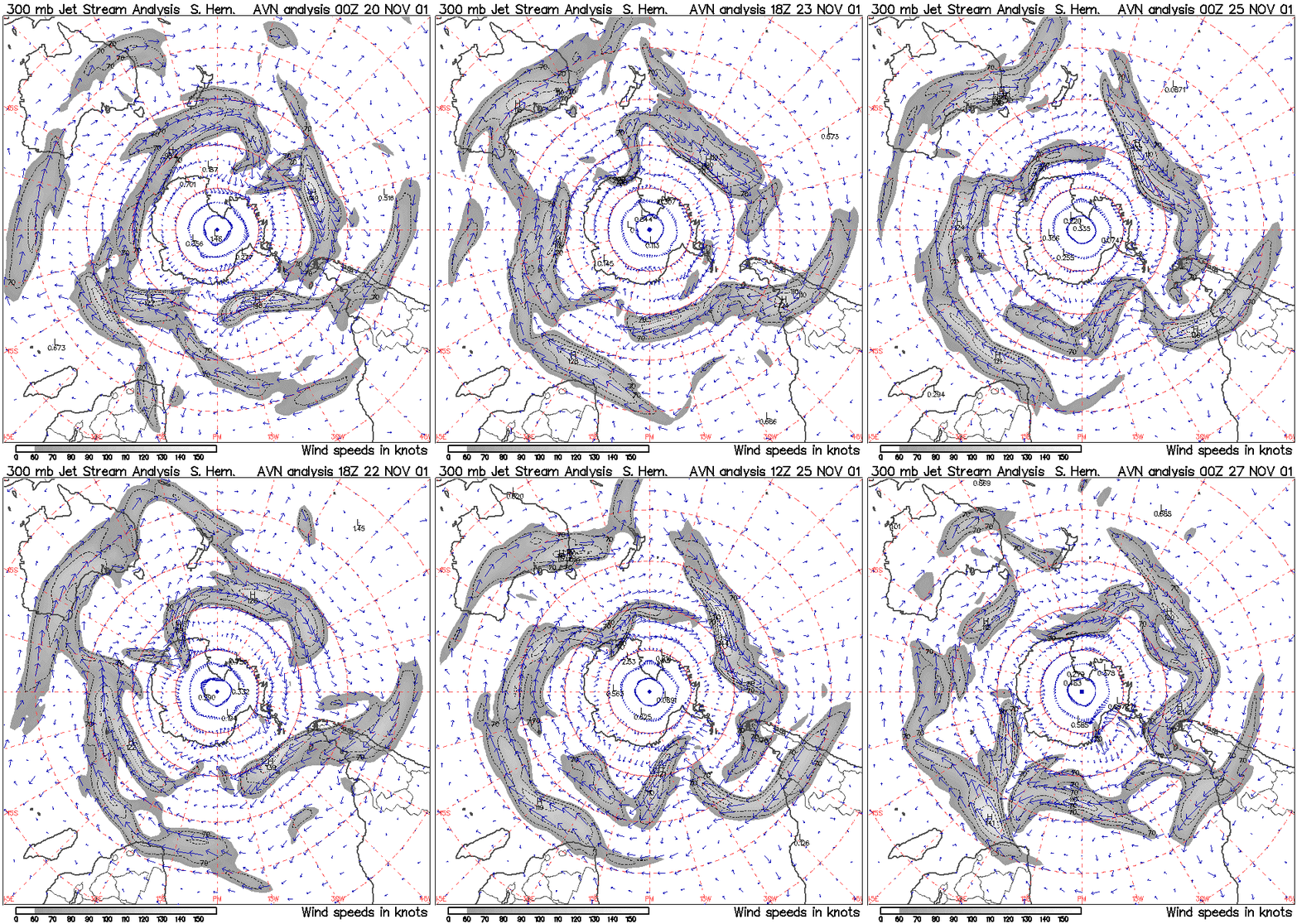
A. Our intercept position at 22h 44m U.T. was also chosento locate the aircraft sufficiently far inland mitigate normal coastalbuffer zone (ice/sea interface) wind effects. The dominant wind patternover the Antarctic plateau (far inland from the coastal regions) is katabatic. That is, the winds are primarily driven by a gravity gradient over therelatively isothermal ice sheet, and there is a strong tendency for thewinds to have low velocity laminar flows. At our chosen latitudefor the eclipse flight (-70S) the high-altitude wind pattern is very stronglycircular, flowing clockwise at low velocity around the pole. We mightexpect winds of only 10-20 knots, though of course anomalous conditionscan arise ("climate is what you expect, weather is what you get"). You canVIEWA GRAPHIC ANIMATION of the Antarctic polar jet stream and the windsover the continent for a weeks period of time centered on 23 November (for2001).
A. Because the Moon's shadow is moving much faster thanthe aircraft, the change in relative speed, even with highwinds, does not have a big effect on the duration of totality. Forexample, a headwind of 100 nautical miles per hour (much more than is expected)would reduce the duration of totality to 2m 25.8s, whereas a tailwind wouldincrease it to 2m 44.9s.
A. The Sun will be 15.0 degrees above the astronomicalhorizon at mid-eclipse. At 38,000 ft, the apparent horizon is depressedby 3.4 degrees, so the Sun will appear to be 18.4 degrees above the apparenthorizon (in the absence of any topographic features).
A. The eclipse intercept is planned such that the Sunwill be "straight out" the port (left) side cabin windows, i.e., 90-degreesto our direction of flight. This will maximize the ease of visibilityout the cabin windows.
A. Technically, yes, as the duration of totality wouldbe maximized by flying an arc following the instantaneous velocity vectorof the Moon's shadow. In practice, however, the aircraft's mid-eclipsetrajectory is such that and the "loss" to the duration of totality is onlyabout 0.1 seconds.
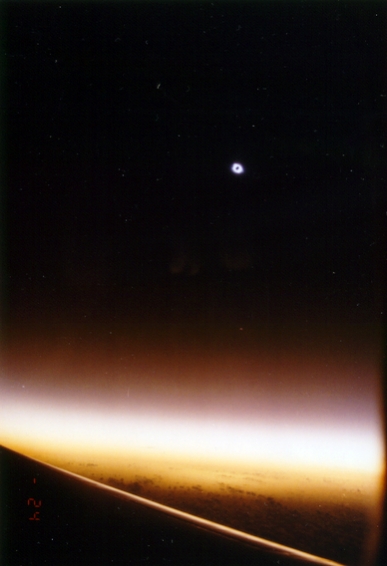
A. Where weather is concerned one can never be completelyassured. However, at 38,000 feet the aircraft will be above 4/5thof the Earth's atmosphere, and at these polar latitudes airborne particulateare extremely low. In the absence of high cloud - which is uncommonbut not impossible - the sky transparency along the line-of-site to thesun should be spectacular, and turbidity should be very low. Thesky, during totality, at 38,000 feet should be quite dark. For acomparative example SEEA WIDE-ANGLE IMAGE of totality at 41,000 feet (similar altitude),and the lunar shadow/sky brightness taken from an aircraft window of the20 June 1992 total solar eclipse over the South Atlantic. High-altitudeparticulate, which cause light-scattering from the illuminated regionsoutside of the shadow, over the Antarctic interior are significantly moresparse than at lower latitudes.
A. By design, the eclipse observation is planned afterthe Antarctic sightseeing portion of the flight. If weather conditionsdictate an intercept later in U.T. (further inland), or (though much lesslikely) earlier in time, i.e., over the Ocean, that can be accommodatedwithin the planned flight margins.
A. We remain highly flexible. The eclipse-observationportion of the flight is nominally planned to be conducted after abouttwo and a half hours of low-altitude sightseeing along the Antarcticcoast. That time can be used in contingency. If we are delayedwe can observe the eclipse first and the sightseeing portion of the flightcan be carried out after totality.
A. The flight pre-planning, including baseline and contingency(alternate) scenarios have been carried out using a highly specializedsoftware package called EFLIGHT which symbiotically synthesizes dynamicalephemerides generation for the eclipse from a moving platform with aircraftnavigation information. EFLIGHT(which is fully described HERE) was designed for in situ on theaircraft flight deck and real-time airborne eclipse navigation. Itwill be used in this manner on the Croydon/QANTAS flight to "guide" theaircraft to an optimal "totality run" and eclipse intercept.
A. At this time, a second Antarctic eclipse flight isplanned, using an Airbus A340 operated by Lan Chile.
A. The QANTAS/CROYDON and LanChile/Sky&Telecope flightplans, showngraphically, and tabulated in detail, were co-operatively and contemporaneouslydesigned for non-interference, and the two aircraft will not be operatingin the same airspace. On a personal note, I have been privilegedto have worked on (and continue to work on) the definition and planningof both flights, and and level of co-ordination between the two flights,to assure their mutual success, has been very high.
A. We have made no special plans, nor levied any requirementson the flight profile for viewing first contact or most of the ingressphase of the partial eclipse, as this nominally will occur during the "sightseeing"phase of the flight. The orientation of the aircraft, as it maneuversfor viewing along the Antarctic coastline, will likely allow some serendipitousviewing of ingress. About a half an hour before totality (the exacttime dependent upon the position of the aircraft) we will break off thesite-seeing portion of the flight and head to a pre-determined "hold" pointjust ahead of the start of the planned flight path for the "totality run". At 15 minutes before mid-eclipse (appx 13m 40s before Contact II) we willcomplete a heading alignment maneuver to put the aircraft on a nearly "straightline" course for a mid-eclipse intercept with the center of the umbralcone at 22h 44m. During the run up to totality the Sun will be essentiallyperpendicular to the direction of flight, "straight out" the left sidecabin windows. This will provide an opportunity to view (and prepare photographicequipment during) the latest stages of the partial ingress phase of theeclipse, including the approach of the umbral shadow and the onset of secondcontact. After third contact the aircraft will continue on the totalityrun track for an additional approximately 4 minutes to view the first stagesof the partial egress phase of the eclipse and the recession of the lunarshadow.
A. Send email to: GlennSchneider (open email window to: gschneider@mac.com)