Is ACRIM 3 Sensitive to Venus's Atmosphere from a Single Transit Event?
At the time of the transit, between contacts II and III, the planetary disk of Venus occulted 0.0942% of the solar photosphere. But, with an optically opaque atmosphere to 60 km (beyond the mesopheric cloud layer) above thesurface the areal coverage was 0.0961%, thus (geometrically) blocking anadditional 0.002% of the received TSI (if not preferentially forward scattered,refracted, or re-radiated by the atmosphere). We tested the abilityto discriminate against a 1% equivalent increment in an Earth-like planetaryradius (by the presence of Venu's opaque atmosphere) in light of both spatialand temporal solar photospheric "surface" brightness (PSB) variations.
The solar PSB decreases radially from the heliocenter because of limb darkening.The PSB is also instantaneously non-heterogenous on angular scales of ~ 1"due to solar granulation, and on larger scales due to features such as sunspots. Thus, the TSI received at ACRIM (and corrected to 1AU) is expectedto vary as Venus occults different portions of the photosphere during itstransit due to spatial variations in PSB, separate from also expected temporalvariations. We investigated the likely amplitudes of PSB variations aftercompensating limb darkening as they may affect ACRIM 3 measures of TSI withcontemporaneous high-resolution imagery obtained with the TRACE spacecraftin its very spectrally broad WL channel (appx. 0.1 - 1.0 microns).
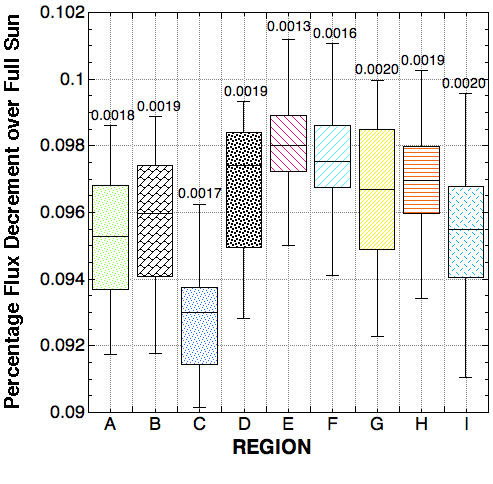
We performed temporally and spatially resolved (and independent) limb-darkeningcorrected differential photometry of regions flanking the location of Venusas it transited (Fig 1) the photosphere. With that we obtained statisticalexpectations of the levels of variability in TSI due to partial photosphericoccultation at the angular scale of Venus (Fig 2).
- Temporal changes in TSI due to Venus occultation of any fixed region of the Sun tested (e.g., denoted A-I in Fig 1) were found to be ~ +/- 0.0018% one-sigma (compared to a 0.0019% expected change in signal)with inter-region variations in internal dispersions of +/- 0.00022%.Hence, a sensitivity to the presence vs. absence of a Venus-like opaque planetary atmosphere was tested at only a 1.05-sigma level of confidence.
- TSI variations due to spatial anisotropies in PSB on Venus-sizeangular scales were found dispersed by ~ +/-0.0015% one-sigma about an expecteddecrement in TSI of 0.0961% due to the presence of Venus imposed on the photosphere with compensation for limb-darkening (I.e., a 1.3 sigma "detection" of theatmosphere of Venus).
The virtual equivalence of the two measures and their uncertainties implicatesno significant systematic effects in this data set from large spatial scalePSB variations (after proper limb-darkening compensation) in excess of limitingdetection sensitivities from temporal effects.
The magnitudes and dispersions of both the temporal and spatial variationsimply, however, only a very marginal ability (at best) to radiometricallydiscriminate the presence vs. absence of a Venus-like opaque planetary atmospherefor an Earth-sized planet - from a SINGLE transit event - not because ofinstrumental limitations, but because of the intrinsic temporal and spatialPSB chaaracteristics of solar-like stars.
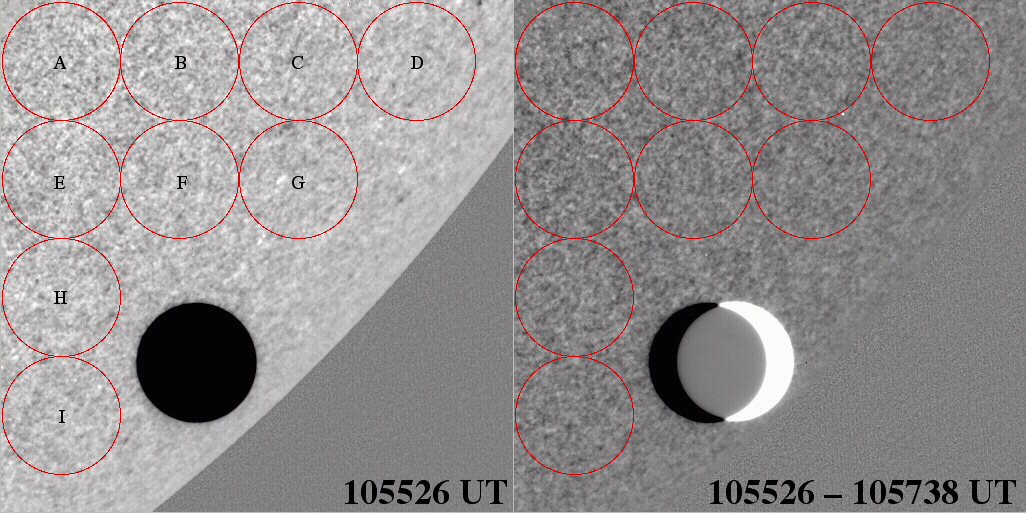
Fig 1. Left: Representative TRACE WL image (one of 100 time-sliced imagesfor this spacecraft pointing spanning 40 minutes of time) of Venus transitingthe solar photosphere with photometric apertures used (each enclosing 10,923 TRACE pixels) to evaluate the temporal and spatial variability of thePSB on the size scale of Venus seen in projection. Right: Differenceimage (at same display dynamic range) illustrating the change in PSB at thecadence of ACRIM 3 sampling (also illustrating the movement of Venus over132s at the indicated times).
Figure 2. Variation in total solar flux density decrement (0.1 to 1.0 microns)due to photospheric occultation by a Venus-size planet arising from temporaland spatial PSB variations (illustrated for 9 regions of the Sun as in Figure1 during the 8 June 2004 Venus transit). Boxes indicate upper and lower quartilesabout measured medians (black lines) of 100 samples. Bars indicate+/- 2-sigma variations about sample means, with 1-sigma (in delta percent)indicted above. (CLICK HERE FORHI-RESOLUTION FIGURE)