08 JUNE 2004 - TRANSIT OF VENUS
INSTRUMENT SETUP IN THESSELONIKI, GREECE
Latitude = 22° 57.5'N , Longitude = 40° 37.0'E,Local Time = UT + 3 hoursLocal Altitude (Zenith up)/Azimuth (increasing to theright) Graphics
Glenn Schneider, Steward Observatory, University of Arizona
Photographs & Graphics from Bryce Babcock, Williams College
Simultaneous grating spectroscopy centered at 530 nm and broadband (adjacent)continuum CCD imagery of the transit of Venus is planned. The spectrograph/imaginginstrument module will be hosted on the Aristotileon University's Secretianrefracting telescope. The module employs a spectral pelical beamsplitter to transmit a narrow wavelength region to the spectrograph whilereflecting the adjacent broad continuum to a CCD imager.
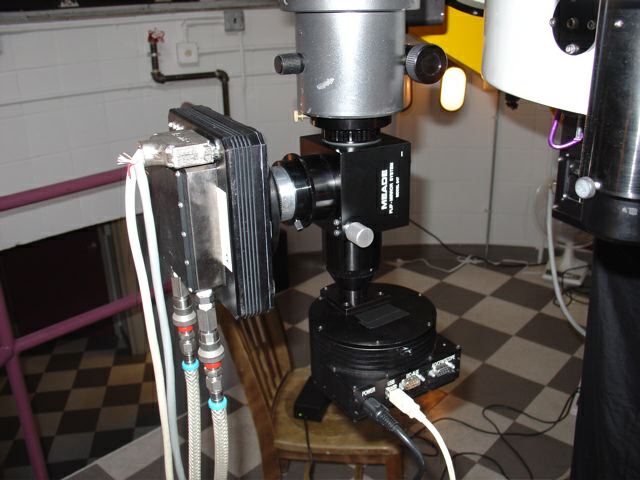
Here, an Apogee CCD imager (left) replaces the fiber-feed for the gratingspectrograph for alignment and focus testing along with an SBIG CCD imagerused for guiding (bottom). Both are coupled to the housing which holdsa beam splitter (and beam attenuating optics) under test at Hopkins Observatory,Williams college.
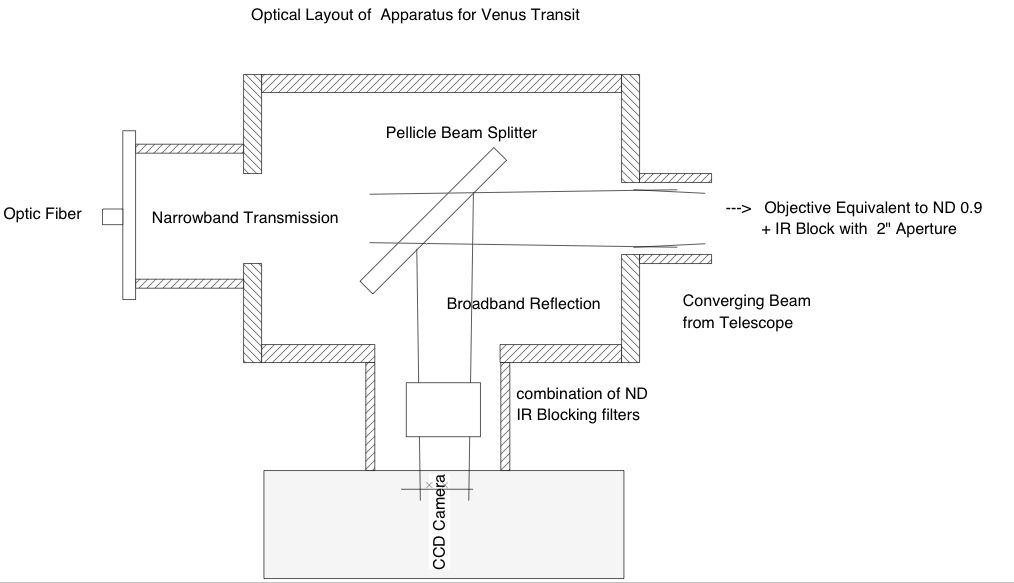
Schematic representation of the beam splitting module.
Why 530 nm? The spectrograph was optimized for observations ofsolar coronal 5303 Angstrom line emission. Serendipitously, variousallotropes of Sulfur, which might be found in the upper atmosphere of Venus(above the optically thick C02 haze layer) absorb optical radiation atnearly the same wavelength. Schneider will be attempting to detecta signature of sulfurous absorption differentially in the solar spectrum(in and out of transit) as reflected off of the Moon (using a spectrophotometeron the Steward Observatory 2.3 meter Bok telescope at Kitt Peak). By observing sunlight in reflection, the entire area integrated spectrumof the Sun is seen at once - mimicing the spatially unresolved spectrumof an extraosolar planetary transit, and testing the ability to detecta "Venus" around another star by this method. The direct spectroscopywith the above instrumental set-up will be obtained while tracking theSun, allowing Venus to drift across a 3" FOV, and obtaining drift-scanspectra across the disk (and atmosphere) of the planet as it transits theSun.