04 DECEMBER 2002
LINDON STATION (FORTEVILLE BORE) SW AUSTRALIA
GLENN SCHNEIDER (gschneider@mac.com)
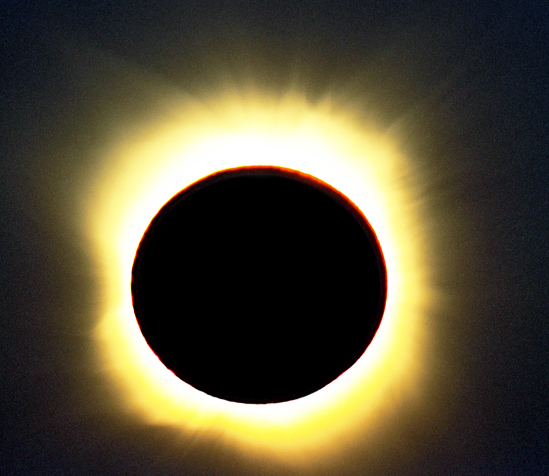
Click HEREfor background information on the preliminary planning for this eclipseobservation.
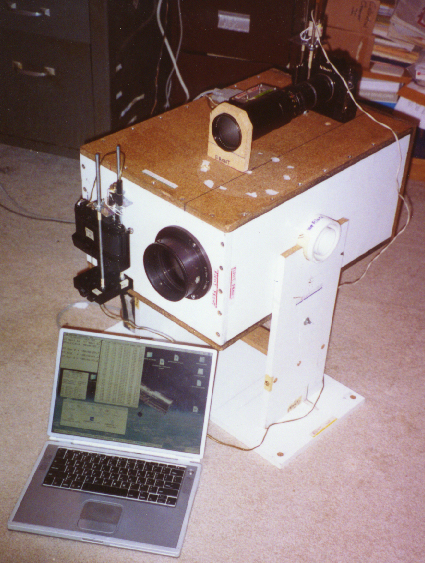
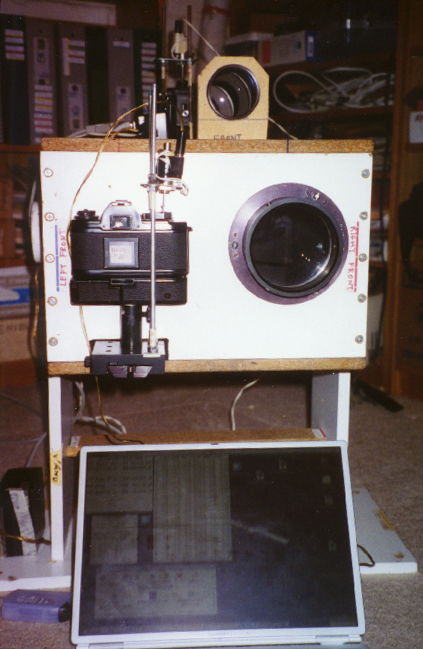
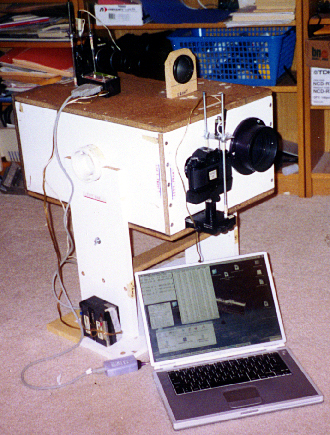
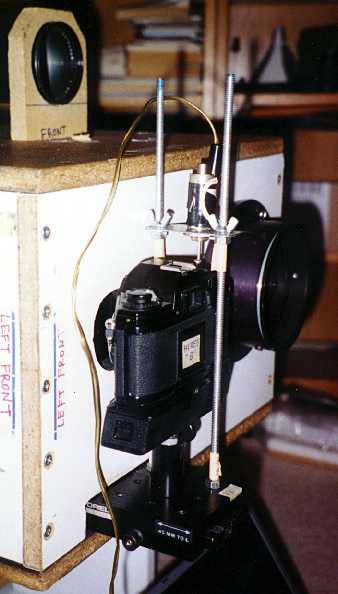
1) A "High Resolution" camera with a 1.2 meter focal length f/12 NIKONachromatic refractor objective lens (3.94" clear diameter), with two 1/8-wavefold-flats, assembed as a ridged "folded refractor".
2) A "Wide Field" camera with a 400mm f/5.6 refracting lens.
Both cameras were fixed to a common mount and operated by the UMBRAPHILEautomated solar eclipse photography S/W, each under electro-mechanicalcontrol of a high-speed solenoid shutter actuator. The camera set-upis shown below:
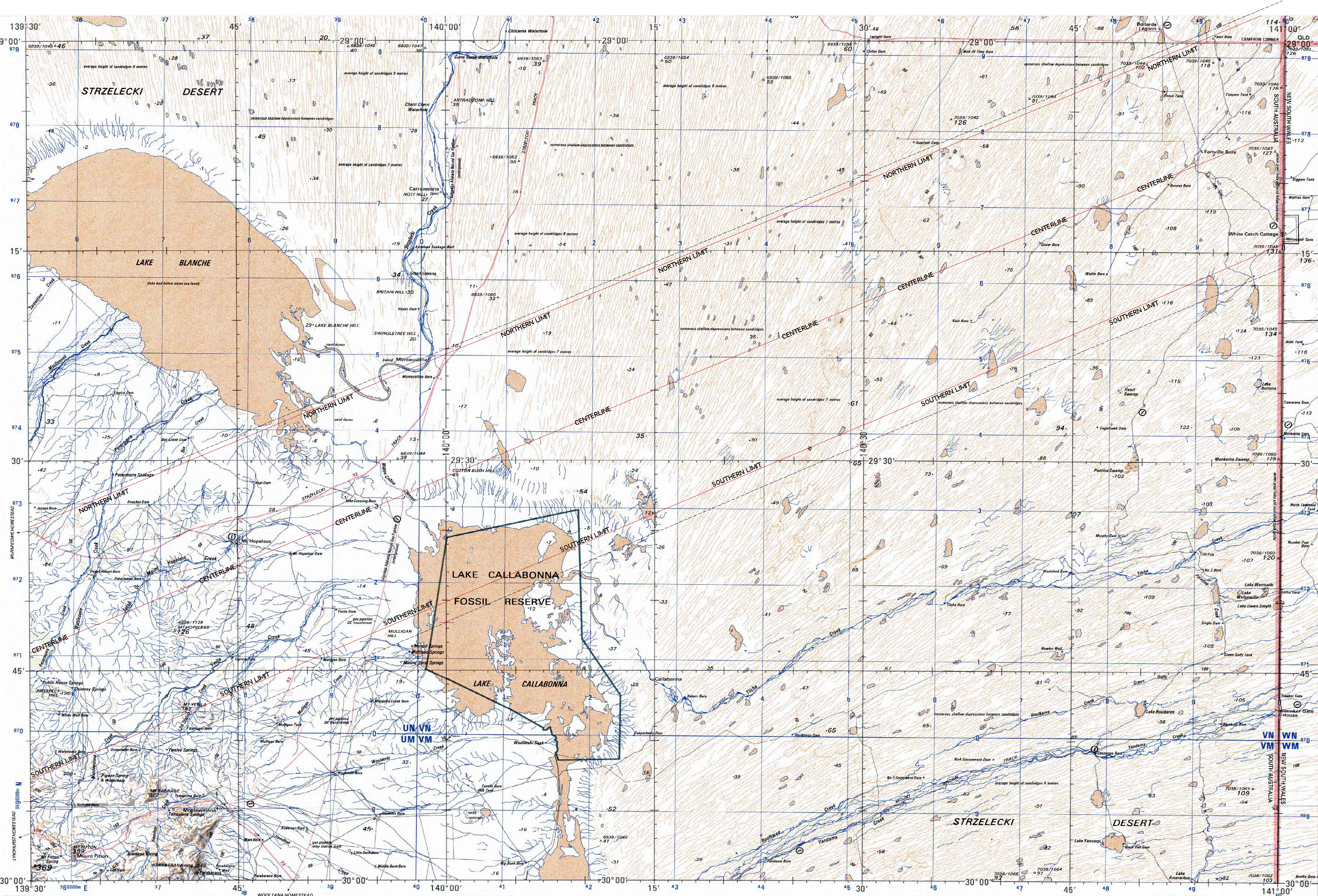
LINDON STATION - FORTVILLEBORE, SOUTH WEST AUSTRALIA
LATITUDE: -029° 07' 53.0''
LONGITUDE: +140° 53' 50.0''
ALTITUDE: 120 meters
With a
PREDICTED (see note on post-facto delta-T correction)
PENUMBRAL DURATION = 01:51:00.9
UMBRAL DURATION = 00:00:26.6
MAXIMUM MAGNITUDE = 1.004
and a
PREDICTED (see note post-facto delta-T correction)
Cnt hh:mm:ss.f Alt° P.A°
1ST 08:14:38.0 +13.1 274.9
2ND 09:11:25.3 +01.5 086.4
MID 09:11:38.6 +01.5
3RD 09:11:51.8 +01.4 266.5
4TH 10:05:38.9 -08.9 093.2
With Lunar Limb Corrections Applied.
EXECUTED UMBRAPHILE 2.4.1A EXPOSURE SEQUENCE
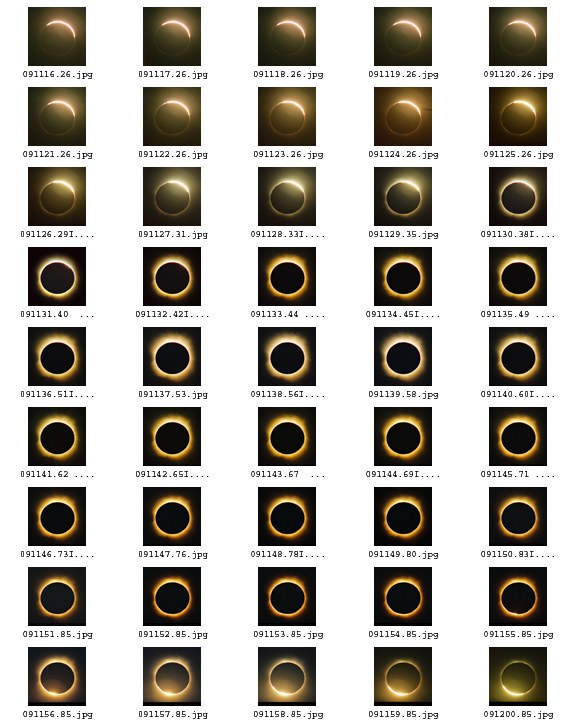
## T-cont T-mid T+CII UT ofEXP DURAT 1/DUR
1 -9.00 -22.29 -9.00 091116.26 0.100 10.00
2 -8.00 -21.29 -8.00 091117.26 0.100 10.00
3 -7.00 -20.29 -7.00 091118.26 0.100 10.00
4 -6.00 -19.29 -6.00 091119.26 0.100 10.00
5 -5.00 -18.29 -5.00 091120.26 0.100 10.00
6 -4.00 -17.29 -4.00 091121.26 0.100 10.00
7 -3.00 -16.29 -3.00 091122.26 0.100 10.00
8 -2.00 -15.29 -2.00 091123.26 0.100 10.00
9 -1.00 -14.29 -1.00 091124.26 0.100 10.00
10 0.00 -13.29 0.00 091125.26 0.050 20.00
11 2.05 -11.25 2.05 091127.31 0.088 11.35
12 4.09 -9.20 4.09 091129.35 0.155 6.44
13 6.14 -7.16 6.14 091131.40 0.274 3.65
14 8.18 -5.11 8.18 091133.44 0.483 2.07
15 10.23 -3.07 10.23 091135.49 0.851 1.18
16 12.27 -1.02 12.27 091137.53 1.500 0.67
17 12.27 1.02 14.32 091139.58 1.500 0.67
18 10.23 3.07 16.36 091141.62 0.851 1.18
19 8.18 5.11 18.41 091143.67 0.483 2.07
20 6.14 7.16 20.45 091145.71 0.274 3.65
21 4.09 9.20 22.50 091147.76 0.155 6.44
22 2.05 11.25 24.54 091149.80 0.088 11.35
23 0.00 13.29 26.59 091151.85 0.050 20.00
24 -1.00 14.29 27.59 091152.85 0.100 10.00
25 -2.00 15.29 28.59 091153.85 0.100 10.00
26 -3.00 16.29 29.59 091154.85 0.100 10.00
27 -4.00 17.29 30.59 091155.85 0.100 10.00
28 -5.00 18.29 31.59 091156.85 0.100 10.00
29 -6.00 19.29 32.59 091157.85 0.100 10.00
30 -7.00 20.29 33.59 091158.85 0.100 10.00
31 -8.00 21.29 34.59 091159.85 0.100 10.00
32 -9.00 22.29 35.59 091200.85 0.100 10.00
As defined by the Umbraphile Data File used:
Exposures 33-38 of sunset partial eclipse (unfiltered)
were triggered manually and exposed at 0.01s (1/100th second)
Images presented here are from low (512x768 pixel) resolution scans(1.13Mb per original file).
Negatives are currently being scanned to 2048x3072 and higher resolutiondigitized images will be available soon.
NO color correction, transformations or brightness/contrast adjustmentshave been made.
ALL images are JPEG compressed (but at "best" quality) for web display,and do
not reflect the quality of the original photographic negatives.
CLICK HERE TO SEE THE PHOTOGALLERY FROM THE "HI-RES" CAMERA
If your browser does not support frames the individual images may befound in the Hi-ResDirectory.
HI-RES images have been registered and cropped, partial phases rotatedto compensate for camera tilt.
UMBRAPHILE 2002: THEMOVIE (QUICKTIME,33.4Mbytes) in Real Elapsed Time
Using the above images I have done a bit of image processing to compensatefor the facts that:
a) The exposure sequence was not temporally centered at mid-eclipsebecause of the 2.5s delta-T error (mea culpa)
b) The totality exposures had a cadence of 1 frame per 2.05s, whilethe diamond ring (DR) exposures were 1 frame per second
c) The planned CII and CIII exposures are shorter (by design) thanthe totality and DR images on either side of them
d) The star and end of the logarithmic ramps are very slightly shorterexposures then the DR exposures.
This sequence would have been optimal for my needs IF it were not offsetfrom mid-eclipse. What I did was:
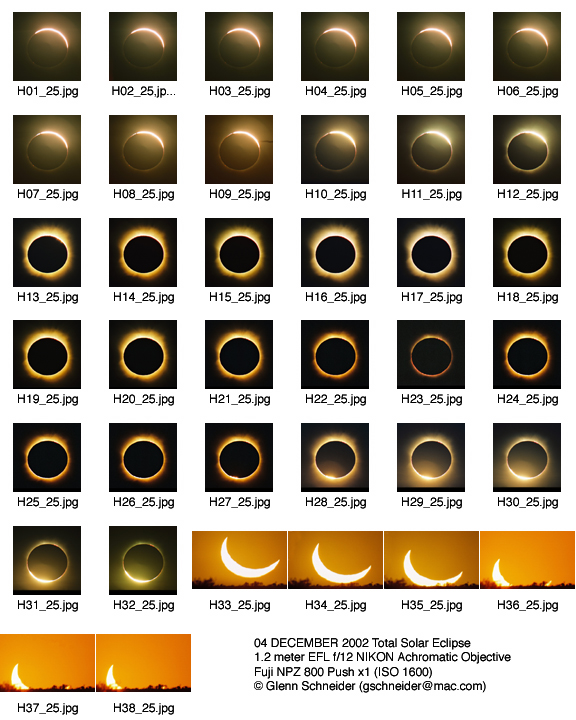
a) Adjust apply multiplicative scaling constants to a few selected framesto achieve (approximately) logarithmically smooth transitions as the
background increased or decreased due to the change in the photosphericextent but asymmetrically w.r.t. the contacts and the planned ramps
b) applied a gamma correction to those frames to re-stretch the contrastappropriately for the adjusted dynamic range
c) augmented one frame which had excessive jitter by using the chromosphericand prominence data from it weighted and combined with radial gradientmasking of the images on either side of it.
Then: For those frames with exposure start times spaced by 2 seconds,I created linerly-weighted (by signal-to-noise on a pixel by pixel basis)interpolated images, to "create" intermediate frames from their immediateneighbors.
It still is not perfect, I suspect because my solenoid control was probablynot accurate in exposure time to better than 5-10% and some empirical adjustmentmay still be necessary. However, for a first unbiased crack at processingI am quite pleased with the results. Here is a:
CONTACT SHEET OF THE HI-RESDATA WITH REPROCESSING AS DESCRIBED ABOVE
And here is UMBRAPHILE 2002:THE SEQUEL (QUICKTIME,5.0 Mbytes) in Real Elapsed Time. Yes, more frames but virtuallythe same size. Beats me how QUICKTIME can do that - but it all waslossless w.r.t. the input resolution. I think you will findit much improved over the original. Indeed, I think you would behard pressed to identify which were the interpolated frames - so I putan "I" after the timecode which identifies them by name. Now, havefun moving the QuickTime slider after you see the movie.
Don't Miss This "Movie"!
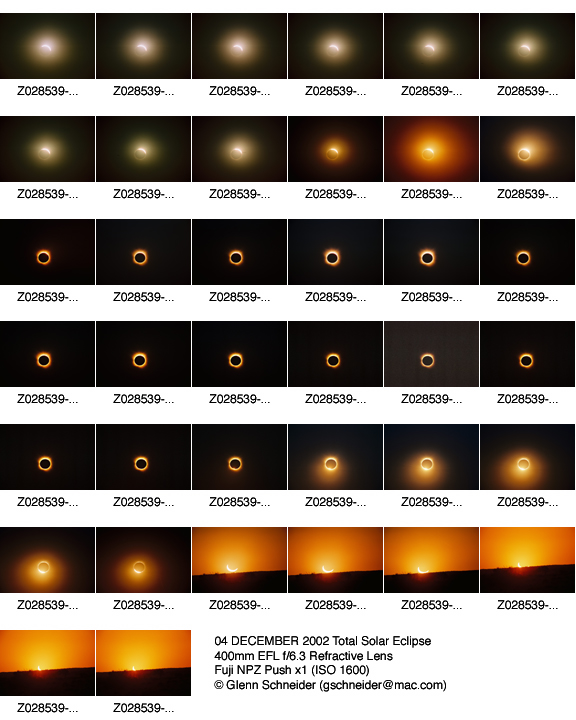
CLICK HERE TO SEE THE PHOTOGALLERY FROM THE "LO-RES" CAMERA
If your browser does not support frames the individual images may befound in the Wide Field Directory.
LO-RES images are raw scans from the CD. Artifacts are from scan,not on negatives.